

Non-surgical rhinoplasty can suit people over 40, but the aim is different from younger patients. With age, the nasal tip often droops and loses projection, making the nose look longer or more hooked. Carefully placed dermal filler can restore support without surgery or downtime. A doctor-led assessment should confirm suitability first, as offered by AL Aesthetics in Solihull, Wolverhampton and Harley Street.
The Nose You Had at 35 Is Not the Nose You Have Now
Most people associate non-surgical rhinoplasty with younger patients wanting a straighter bridge or a less prominent bump. That image is not wrong, but it is increasingly changing. In 2026, the fastest-growing group booking this treatment is women over 40, and they are coming in for entirely different reasons. They are not seeking cosmetic refinement of a feature they have always disliked. They are responding to changes that appeared gradually and became impossible to ignore once video calls and high-resolution photographs became a daily fixture of professional life.
If you are in your forties and have started to feel that your nose looks different in photographs than it used to, you are not imagining it. The nose genuinely does change throughout adult life, and understanding why matters before you make any decision about treatment.
What Non-Surgical Rhinoplasty Actually Involves
Before addressing the age-specific concerns, it is worth being clear about what the procedure is. Non-surgical rhinoplasty uses small, precisely placed amounts of dermal filler to reshape the nose. There is no anaesthetic, no incision, and no surgical recovery period. Most appointments take under an hour, and patients return to work the same day or the following morning.
In younger patients, the treatment is most often used to smooth a bump on the bridge or improve symmetry. In patients over 40, the clinical rationale shifts. The priority becomes restoring projection that has been lost as nasal tip cartilage weakens and soft tissue droops over time. That is a structurally different problem, and it requires a practitioner who recognises the distinction.
How the Nose Changes After 40
The nose is not static. It continues to alter throughout adult life in ways that are gradual enough to go unnoticed year to year but become clear when you compare photographs from five years apart.
The most significant change for most women over 40 is a drooping nasal tip. As the cartilage that supports the tip loses its structural strength and the soft tissue above it descends, the tip rotates downward. At rest, this may be subtle. The change becomes much more pronounced when you smile, because the muscles involved in smiling actively pull the tip further downward. This is why many patients say their nose looks longer or more hooked in photographs than it does in the mirror. They are both right: the two situations genuinely produce different results.
Alongside this, the profile can become more convex as tip projection reduces. A nose that had a relatively straight profile in a patient's thirties may appear to have developed a hook that was not previously there. This is not always because the bone has changed; often, it is because the tip has dropped relative to a bridge that has remained the same.
Skin thinning also plays a role. As skin loses collagen and becomes less substantial, any pre-existing asymmetry becomes more visible under direct lighting. Video calls, with their flat frontal lighting and close framing, are particularly unforgiving. A feature that was barely noticeable in conversation becomes a source of self-consciousness when it appears on screen in a professional meeting several times a week.
These changes typically accelerate between 40 and 50. They are not extreme, and they are not a reason for alarm, but they are real, and they deserve a clinical response that takes them seriously.
Why This Matters More Now Than It Did Ten Years Ago
A concern that once surfaced occasionally, perhaps at a wedding or in a professional headshot, now appears on screen daily. For women who present regularly to clients or stakeholders, who appear on internal video calls and external panels, the way they look on camera is no longer an occasional consideration. It is a constant one.
Surgical rhinoplasty is one option, and for some patients it remains the most appropriate route. But surgical rhinoplasty involves several weeks of downtime, significant bruising and swelling, and a recovery period that is genuinely impractical for anyone with a busy diary. The result is also permanent, which raises the stakes considerably when the concern being addressed is an age-related change rather than a fixed structural feature.
Non-surgical rhinoplasty sits in a different category. It requires no time off work, produces results that can be assessed and adjusted over time, and carries a safety profile that is well established when the treatment is delivered by a qualified medical professional. For career-focused patients who want a realistic, considered solution, this makes it both clinically and practically relevant in a way that surgery often is not.
Why So Many Women Over 40 Dismiss This Treatment Prematurely
Here is where most online content fails older patients. The vast majority of articles and social media content about non-surgical rhinoplasty is written with a younger audience in mind. The before-and-after images show bridge refinement. The language focuses on cosmetic shaping. Older patients read this and reasonably conclude that the treatment is not for them, or that surgery is the only credible option for the concerns they are experiencing.
This is a significant gap. The structural reasons why women over 40 develop concerns about their nose are well understood clinically, but they are rarely explained in accessible terms. The result is that a group of patients who would genuinely benefit from a frank conversation with a qualified practitioner either delays seeking advice or rules out the most appropriate option before they have had that conversation.
If you have dismissed this treatment as something for younger patients, it is worth reconsidering on the basis of the structural changes described above rather than on the basis of how the treatment is typically marketed.
How to Assess Your Own Concerns Honestly
Before booking any consultation, it is useful to gather your own evidence. Take photographs of your natural profile, not a posed angle with your head tilted. Compare these with photographs from approximately five years ago, taken in similar lighting and from a similar angle.
Look specifically at the nasal tip. Has it descended? Does the profile appear more convex than it did? Does the nose appear longer when you are smiling than when your face is at rest? These are indicators of age-related nasal descent rather than fixed structural features. They are also the kind of changes that respond well to carefully placed dermal filler when the treatment is planned appropriately.
A photograph review of this kind is not a diagnosis. It is a starting point for a structured conversation with a practitioner who can assess your facial anatomy properly and advise on whether treatment is appropriate and what realistic outcomes would look like. The key word is realistic: a good practitioner will tell you honestly what this treatment can and cannot achieve for your specific concerns.
The AL Aesthetics Approach for Patients Over 40
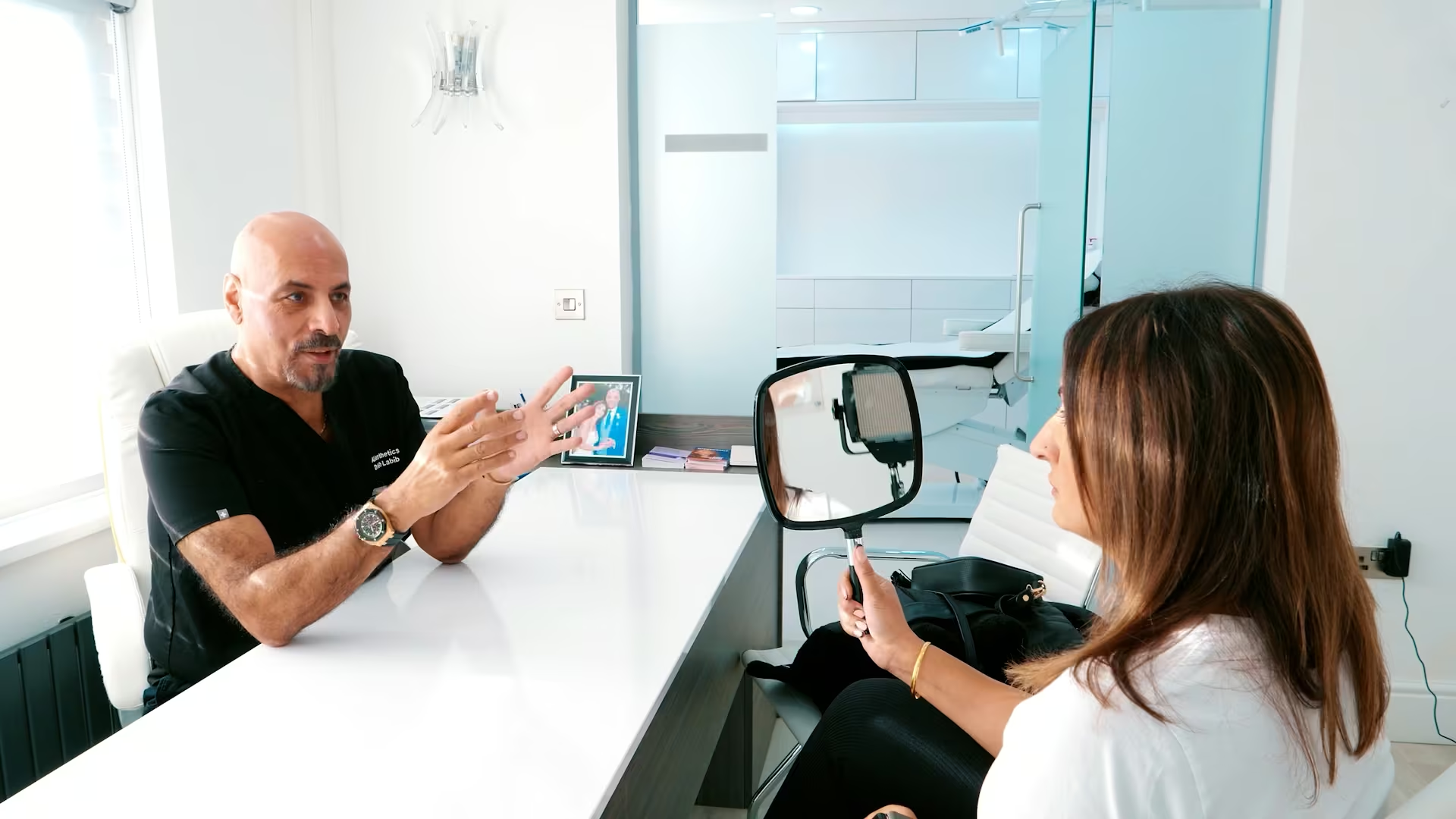
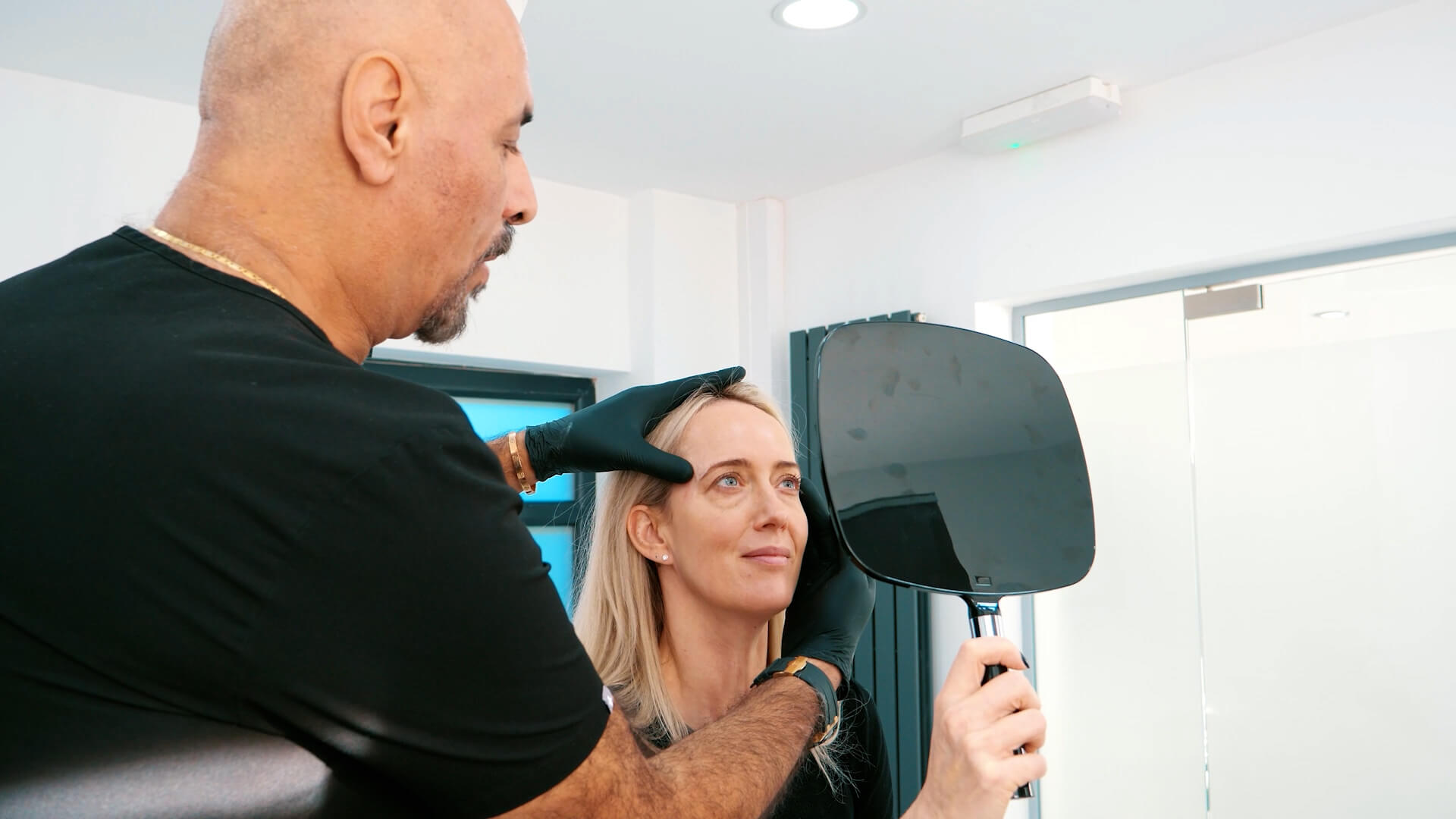
AL Aesthetics is a CQC-registered, doctor-led clinic with locations in Solihull, Wolverhampton, and Harley Street in London. Every non-surgical rhinoplasty at AL Aesthetics begins with a detailed facial assessment conducted by an experienced medical professional, not a beauty therapist or a non-clinical practitioner.
For patients over 40, this assessment is particularly important. Age-related nasal changes vary considerably between individuals. The degree of tip descent, the extent of skin thinning, and the overall facial structure all influence both whether treatment is appropriate and precisely how it should be approached. A clinical assessment that looks at your facial anatomy as a whole, rather than the nose in isolation, is the foundation of a result that looks considered rather than obvious.
The doctor-led model also means that the practitioner conducting your assessment has the medical background to understand the structural changes described in this article and to discuss them with you in clinical terms. If treatment is not appropriate for your specific concerns, you will be told that clearly. If it is appropriate, you will receive a treatment plan that reflects your individual facial structure and ageing pattern rather than a standard approach applied uniformly to every patient.
For patients who have wider concerns about facial ageing alongside their nasal concerns, the clinic also offers a range of complementary treatments, including dermal fillers for the cheeks and chin, Profhilo, and skin boosters, which may form part of a broader treatment plan discussed at consultation.
A Different Conversation for a Different Patient
Non-surgical rhinoplasty at 40 or beyond is genuinely not the same procedure as at 25. The structural concerns are different, the clinical rationale is different, and the outcome that constitutes success is different. A treatment that restores tip projection and improves a drooping profile has a different purpose from one that smooths a bridge bump, and it demands a different level of clinical assessment to plan properly.
Understanding this distinction is the first step towards an outcome that addresses your actual concerns rather than a generic idea of what the treatment is for. If you have been watching changes in your nose over the past few years and wondering whether anything can be done without committing to surgery, the answer is worth exploring properly.
Book a consultation at AL Aesthetics to receive a frank, medically grounded assessment of whether non-surgical rhinoplasty is appropriate for your specific concerns and what you can reasonably expect from treatment. There is no obligation to proceed, and no pressure to do so. The consultation exists to give you the information you need to make a considered decision.
Find out more about non-surgical rhinoplasty at AL Aesthetics and book your consultation.